A five-year coordinated project between the AIR group (UCLM, subproject C21, coordinator) and the Hospital Nacional de Parapléjicos de Toledo (subproject C22), structured in ten tasks.
Sep 2021Start of the project
Aug 2026End, after a 12-month extension approved by the AEI
10tasks shared between UCLM and HNPT
9 / 9coordinated objectives achieved at 100%
Objectives
What the project set out to do, and what was achieved
1
State of the art, user needs and requirements (T1)
Requirements built with HNPT clinicians from real use cases. The review of the evidence led to a systematic review and meta-analysis (American Journal of Physical Medicine & Rehabilitation, Q1) and a systematic mapping study on AI in neurorehabilitation (IEEE Access).
100%
2
Conceptual design of the platform (T2)
Multi-layer architecture with a reusable core: every serious game inherits hand interaction, kinematic logging and adaptation mechanisms. Published in SoftwareX.
100%
3
Core of the immersive platform (T3)
Pinch and grip recognition, hand tracking, head and trunk monitoring, kinematic logging, and individual calibration of the safe range of motion. Released as open software.
100%
4
fMRI acquisition and processing protocol (T4)
Led by the HNPT. Delayed by the replacement of the hospital's MRI scanner, it was completed during the extension. The goal is to quantify the cortical representation area of the hand: a motor paradigm alternating rest and wrist flexion-extension, suitable for healthy participants and people with cervical SCI, plus the image processing methodology. fMRI is one of the pre- and post-intervention assessments of the final study; part of the methodology was presented at CASEIB 2026.
100%
5
Kinematic analysis of upper-limb movements (T5)
Comparison of physical, semi-immersive and immersive modalities. Range of motion at the elbow and wrist differs between real and virtual environments in both populations (and, in SCI, also shoulder ROM and trunk displacement); speed and smoothness drop in VR. Validation of the smoothness metric and a browser-based tool for post hoc kinematic analysis (Software Impacts, 2026).
100%
6
VR applications and serious games (T6)
Refactoring of the RehabHand applications (DPI2016-77167-R) and new games, automatic creation of accessible environments, fatigue detection and mixed reality with sensorised objects. Clinical definition shared by both subprojects; development at UCLM, except the virtual version of the GRASSP test, developed by the HNPT.
100%
7
Cloud integration (T7)
RIAH cloud platform for synchronisation, versioning and visual analysis of session data, with GDPR-compliant security, extended with the Physio Galenus decision support platform.
100%
8
Functional validation (T8)
Final study at the HNPT with 6 patients with cervical SCI and 5 healthy participants, 15 sessions each and pre/post assessment with a battery of clinical scales, approved by the Toledo Hospital Complex ethics committee. Partial results at ISCOS 2025, IBERDISCAP 2025, SEP 2026 and CASEIB 2026. Extended to the Hospital General Universitario de Ciudad Real (haemodialysis, July 2026). Data published openly.
100%
9
Exploitation and dissemination (T9)
11 journal articles, 2 book chapters, 23 conference communications plus a workshop, 4 doctoral theses, 9 open repositories with DOI, media presence and outreach.
100%
Schedule
Original work plan
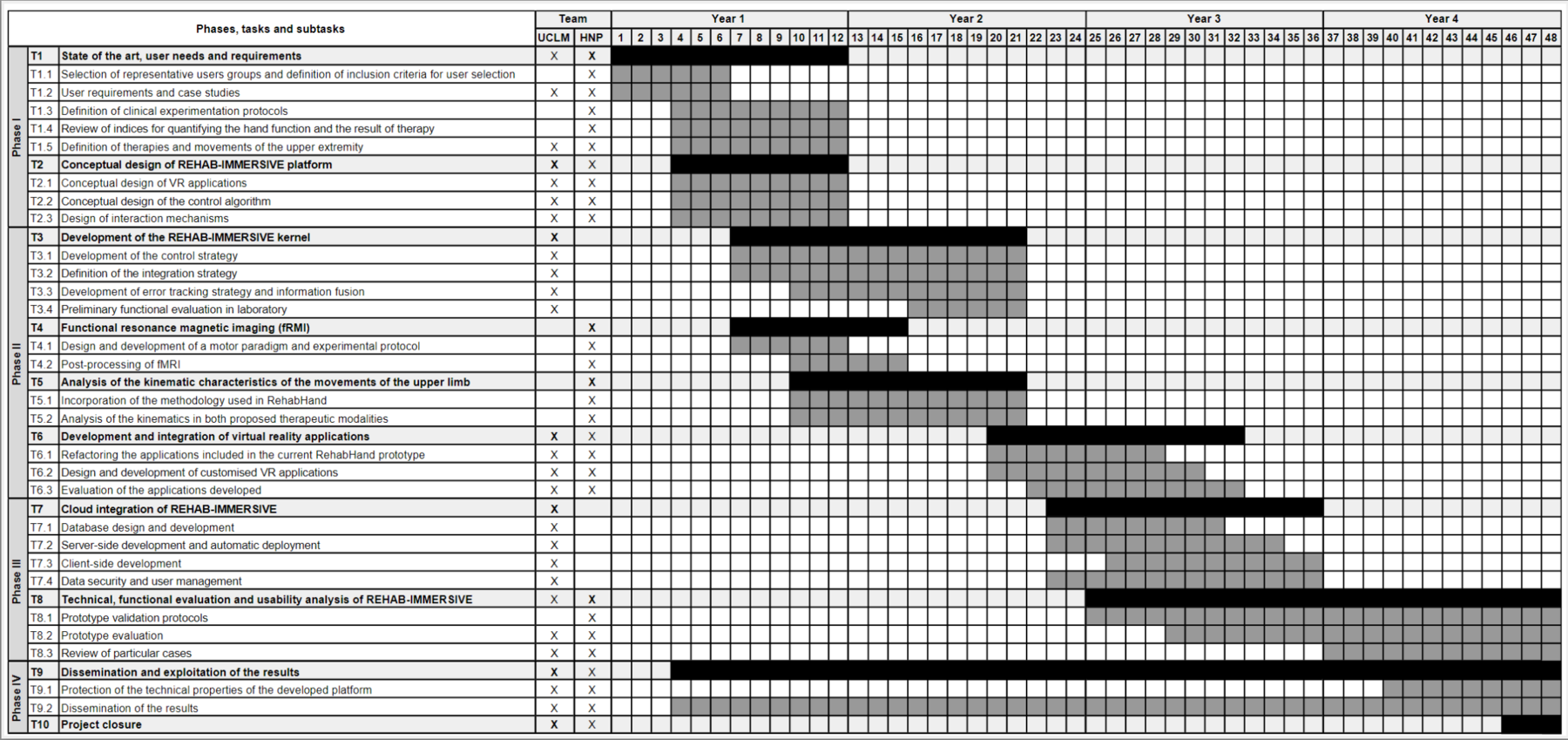
Four years and ten tasks, from September 2021. The Spanish State Research Agency approved a 12-month extension (resolution of 16 June 2025), moving the end date to 31 August 2026, because the replacement of the HNPT's MRI scanner delayed the fMRI task (T4) and, with it, the broad clinical study (T8). Objectives, work plan and budget were not modified.
Original schedule of the coordinated project.
Tasks
Task description
T1 · State of the art, user needs and requirementsHNPT
Review of current technology throughout the project
Selection of representative user groups
Joints and movements to rehabilitate
Testing protocol, including ethics committee approval
Metrics and evaluation criteria
T2 · Conceptual designUCLM
Target users, joints, movements and architecture
User needs incorporated into the design
Algorithms to adapt therapy to hand tracking and VR devices
T3 · Development of the coreUCLM
Core system integrating the RehabHand components
Control of the VR applications through the sensors
Reliable motion tracking
Functional laboratory tests
T4 · Functional MRIHNPT
fMRI to detect improvement after rehabilitation
Motor paradigm and protocol for healthy and SCI participants
Voxel-based morphometry and cortical thickness analysis
T5 · Kinematic analysisHNPT
Kinematic capture and performance indices
Comparison of desktop and immersive virtual tasks
T6 · VR applicationsUCLM
Overcoming the limits of the earlier Leap Motion prototype
New patient-adapted tools and serious games
Iterative integration and testing
T7 · Cloud integrationUCLM
Cloud deployment for access by external medical centres
Security, data privacy and user management
T8 · Technical, functional and usability evaluationHNPT
Verification against the T1 specifications with potential users
Execution of the evaluation protocols
Indicators of applicability (clinical efficacy out of scope)
T9 · Dissemination and exploitationUCLM · HNPT
Partnerships to take treatment beyond the hospital
Intellectual property and open publication
Scientific dissemination
T10 · Project closureUCLM · HNPT
Final scientific and technical report
Administrative closure
Coordination
Milestones between UCLM and HNPT
Regular face-to-face and online meetings, joint experimental sessions at the hospital and co-authored papers throughout the project.
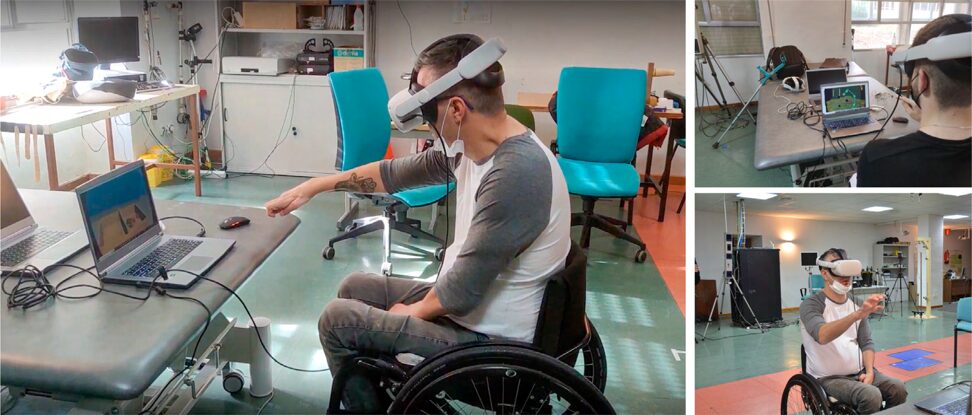
Experimental session at the Hospital Nacional de Parapléjicos.
Kick-off meeting at the Escuela Superior de Informática (Ciudad Real).
AIR visits the HNPT Biomechanics Department to define the core functionality.
First experimental session with Box & Block; research stay at Durham University.
Sessions comparing physical, semi-immersive and immersive modalities; framework published in SoftwareX.
Calibration and accessibility sessions at the ESI and the HNPT; first functional MRI of the protocol (29 Feb 2024).
Visit to Toledo: extension, VR-ADAPTA simulator and long-term experimentation.
Favourable opinion of the ethics committee (CEIm) of the Toledo Hospital Complex for the final study.
Experimental session with the adapted handball game.
Final experimental study (T8) at the HNPT; partial results at SEP 2025, ISCOS 2025, SEP 2026 and CASEIB 2026.
Vanesa Herrera defends her doctoral thesis.
Platform presented by Vanesa Herrera at the seminar of the HNPT Associated Unit to CSIC, organised by Juan Moreno (CSIC) and Ana de los Reyes (HNPT) at CAR-CSIC, Arganda del Rey.
Sessions with sensorised objects and mixed reality, which led to the XR 2026 paper (Salento).
Joint public presentation to the media of Rehab-Immersive (PID2020-117361RB-C21/C22) and ReGAIT (PID2021-124111OB-C31/C32/C33) at the HNPT.