What we learned
The main finding: safety and accessibility can be guaranteed automatically, by design, by adapting the environment to each patient instead of asking the patient to adapt to the environment.
Four years of sessions at the hospital
Every component was validated with patients with cervical spinal cord injury and healthy volunteers, at the Hospital Nacional de Parapléjicos de Toledo and in the laboratory at the Escuela Superior de Informática. The studies covered usability, acceptance, safety (compensations and cybersickness), kinematics and fatigue.
- Comparison of physical, semi-immersive and immersive modalities (2022–2023)
- Calibration and automatic adaptation (ESI and HNPT, 2024)
- Adapted handball serious game (2024–2025)
- Mixed reality with sensorised objects (2026)
- Final experimental study (T8, Sep 2025 – Aug 2026): 6 patients with cervical SCI and 5 healthy participants, 15 sessions each, pre/post clinical assessment and fMRI
- Haemodialysis pilot at the Hospital General Universitario de Ciudad Real (July 2026)
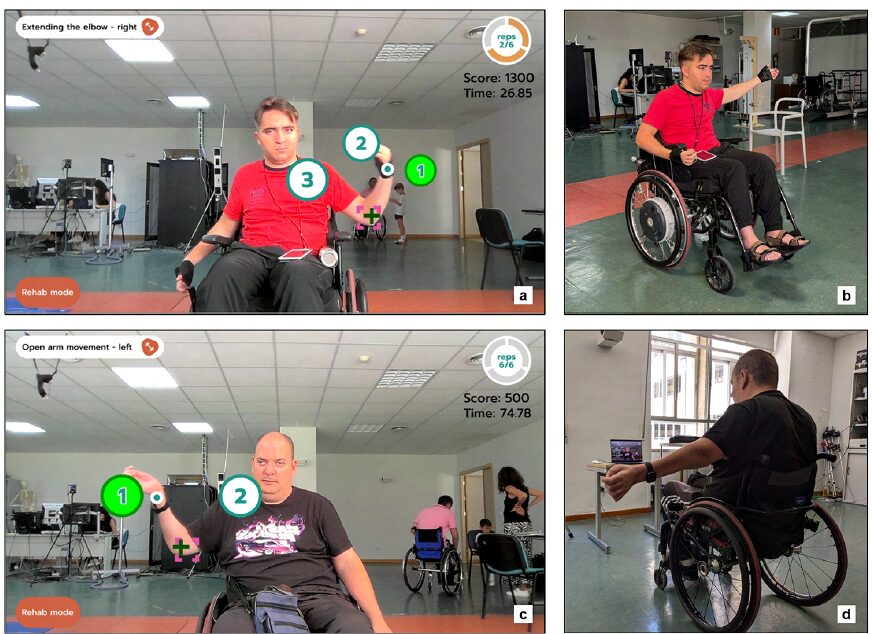
What a session records
Every exercise produces data: hand joints, grips, head and trunk posture and body poses, which feed the kinematic and fatigue analyses.
The numbers behind the platform
Task completion, automatic adaptation vs standard layout
Mean time per block, patients with SCI
24 participants (14 with spinal cord injury, 10 healthy). Virtual Reality, 2025.
Usability (SUS, 0–100)
Immersive vs non-immersive: p = 0.043. Cybersickness remained low (VRSQ 0–25).
Interaction
Patients rated the immersive environment with hand interaction far above the non-immersive one: interaction quality 4.67 vs 2.67, grasping and releasing 4.83 vs 3.00, presence 4.83 vs 2.50 (out of 5).
Kinematics
In Explorer, patients showed more velocity peaks (42 vs 24, p < 0.05), longer paths (1.12 m vs 0.91 m) and lower speeds than healthy participants: an objective marker of movement quality. In both groups, speed and smoothness decrease in VR compared with the real task (CASEIB 2023).
Safety
In the handball game, 100% of recorded movements stayed within the calibrated safe range, as validated by HNPT clinicians.
Fatigue
Four-level fatigue model with an error below 15% against self-reported fatigue, consistent with therapists' observations in nine patients.
Evidence base
Consortium meta-analysis of 10 randomised trials (367 participants): immersive VR improves upper-limb motor function (SMD 0.56) and activities of daily living (SMD 0.74).
Neuroimaging
Functional MRI protocol to quantify the cortical representation of the hand (rest and wrist flexion-extension), designed for healthy participants and people with cervical SCI and used as a pre/post assessment in the final study (CASEIB 2026).
An honest gap: in the Box and Block Test, participants moved 83.7 blocks in the physical version and 69.2 in VR. Closing the distance between virtual and real manipulation is one of the starting points of the follow-up project, Smart-RehabAR.
Awards
NIDS 2024
Fatigue detection model for upper-limb rehabilitation in VR. Athens, Greece.
CEIG 2024
Best paper: dynamic adjustment of interactive objects in virtual environments. A Coruña.
XoveTIC 2025
VR-ADAPT environment for new wheelchair users with spinal cord injury.
Disability award
Master's thesis on a VR puzzle serious game generator.
Also: finalist for the Best Student Paper Award at ICEIS 2023 (Prague). The previous project, RehabHand, received the ITEMAS quality seal in 2024.
Doctoral theses
Análisis del nivel de fatiga periférica asociada al entrenamiento con dispositivos tecnológicos en lesionados medulares cervicales
Miriam Salas Monedero · Supervisors: José Fernando Jiménez Díaz, Ana de los Reyes Guzmán and Sonsoles Hernández Sánchez · Defended 2 October 2024 · Sobresaliente Cum Laude. Linked to the HNPT subproject.

Safe, adapted and accessible immersive systems for upper-limb rehabilitation in patients with spinal cord injury
Vanesa Herrera Tirado · Supervisor: Javier Albusac · Defended 10 July 2025 · Sobresaliente Cum Laude. The core thesis of the project.
Architectural and experimental model for immersive VR environments in e-commerce platforms
Rubén Grande Muñoz · Supervisors: Javier Albusac and José Jesús Castro-Schez · Defended 2 October 2026 · Sobresaliente Cum Laude, International Mention.
Artificial intelligence to support physiotherapy for patients affected by neurological diseases
Sergio Martínez Cid · Supervisors: David Vallejo and Santiago Sánchez Sobrino · Defended 15 October 2026 · Sobresaliente Cum Laude, International Mention.
The project also produced several bachelor's and master's theses, including the RIAH cloud platform, the haemodialysis application, the sensorised objects for augmented reality, the handball game and the puzzle generator.
Software and data, openly available
Nine repositories with a permanent DOI, MIT or CC BY 4.0 licences, ORCID-linked metadata and funding information, following the FAIR principles.
Rehab-Immersive
VR framework for upper-limb rehabilitation with a Box and Block demo for Quest. SoftwareX 2023.
Accessible-Rehab
Individual calibration and automatic adjustment of virtual objects to the safe range of motion. Virtual Reality 2025.
VR-Hands-Interactions-Adapted
Data and scripts on hand interactions in adapted and non-adapted environments. IEEE Access 2025.
RehabImmersive-Kinematic-Analysis
Browser-based post hoc kinematic analysis and VR games for Meta Quest. Software Impacts 2026.
Fatigue-Detector-Rehab
Model to estimate fatigue during Box and Block, with analysis and reporting utilities. Information 2025.
Rehab-HandballVR
Kinematic records and performance metrics of nine participants in the adapted handball game.
Physio-Galenus
Modular decision support platform for AI-supported physical rehabilitation. SoftwareX 2026.
Rehab-Immersive HNPT final study
Session results of the immersive games and pre/post clinical assessments of people with cervical SCI and healthy controls. CC BY 4.0.
Where Rehab-Immersive goes next
Smart-RehabAR (2026–2029)
Coordinated project PID2025-167775OB-C21/C22 between UCLM and HNPT, funded with €386,375 in the 2025 Knowledge Generation call after its subprojects scored 94.3 (UCLM) and 90.9 (HNPT) out of 100. It turns the limits found in Rehab-Immersive into goals: hybrid augmented reality environments with sensorised physical objects, continuous in-session adaptation guided by explainable AI, multimodal FAIR data in the cloud and functional electrical stimulation for patients with greater impairment.
Transfer and collaboration
Hospital General Universitario de Ciudad Real: VR exercise during haemodialysis, validated in July 2026. Indra and Fundación Universia: VR-ADAPTA project for new wheelchair users. Durham University: international collaboration with Prof. Dorothy N. Monekosso. Universitat Jaume I: formal agreement between the HNPT and the Biomechanics and Ergonomics group to test new biomechanical methods and extend them to neurological conditions; the HNPT also takes part in its CIAICO/2023/067 project on low-cost hand exoskeletons. VRINHAX: collaboration with the HNPT Biomechanics Unit to bring other virtual applications for neurological patients into the clinic. A pilot study with the RehabHand software has also been carried out with patients with cerebral palsy. Furious Koalas S.L., a UCLM spin-off founded by members of the AIR group, is the natural route to bring the results to market.